



SEO Last Month: The Biggest Google Search Updates from September 2026 (H1)
 5 Minutes Read

September 2026 brought several important changes across Google Search, AI, Google Ads, Analytics and local search. The overall direction is clear: Google is moving from traditional search results towards AI-driven, multimodal and action-oriented experiences.
Key Google Updates
Google Trends gets category filters
Date: 2 September 2026
On 2 September, Google added category filters to the Google Trends Explore page. Users can now filter by category, region and time period, with or without entering a search term, making it easier for marketers and content teams to identify relevant topics and avoid unrelated search trends.
AI becomes a bigger part of Search
Date: 2 September 2026 (Gemini 3.8 Flash) and 4 September 2026 (AI Mode ads test)
Gemini 3.8 Flash arrived in AI Mode on 2 September, the same day Google released the model. It is available to Google AI Pro and Ultra subscribers worldwide and brings improvements in coding, reasoning and multi-step tasks. On 4 September, Google confirmed a small experiment serving standard exact-match and phrase-match search ads within AI Mode, limited to queries with explicit, direct intent.
Google Ads gets smarter reporting
Date: Rolling out to accounts from early September 2026 (announced 10 August 2026)
The new Gemini-powered Ads Dashboards, first announced on 10 August, began appearing in advertiser accounts in early September. They can generate charts, tables and performance summaries from natural-language prompts. However, marketers still need to verify AI-generated insights and conversion data before using them in reports.
Business Profiles become more AI-driven
Date: 14 September 2026
On 14 September, Google made the “Collected Info” tab in Google Business Profileofficially available. Google’s automated assistant can contact businesses through automated calls, SMS or WhatsApp to confirm details such as opening hours, curbside pickup and accessibility. The new tab shows what was gathered, along with its source and date, and lets owners delete outdated details. The feature is currently limited to select regions, languages and business categories. Local businesses will need to regularly monitor and correct this information.
AI expands advertising and commerce
Date: 18 September 2026 (video dubbing) and 18–22 September 2026 (Shopify checkout)
On 18 September, Google Ads began rolling out AI video dubbing in Asset Studio to select advertisers, translating existing video ads into 33 languages and locales. In the same week, Google widened native checkout, and eligible US Shopify merchants were notified that customers can now discover and buy their products directly in AI Mode and the Gemini app. Merchants are enrolled by default and can opt out from their Shopify admin.
Search Console becomes more multimodal
Date: 24 September 2026
On 24 September, Google split Web search performance in Search Console into Text-based and Multimodal results. Multimodal covers searches where an image was used, such as Google Lens, Circle to Search and image uploads, and does not include query data. This is particularly relevant for ecommerce, fashion, food, furniture and visually driven businesses.
Discover and AI Mode continue evolving
Date: 18 September 2026 (Discover test) and 29 September 2026 (AI Mode monitoring)
On 18 September, Google began testing a “Dive deeper” button in Discover that opens an AI-generated topic overview with links to related stories, starting with videos. On 29 September, AI Mode monitoring was rolled out to all users globally after being limited to paid subscribers, allowing users to track products, prices and local opportunities automatically.
Analytics and tracking updates
Date: 8 September 2026 (Store Sales announcement) and 21 September 2026 (GA4 hostname filter)
On 21 September, Google Analytics added an Include (allowlist) option to hostname data filters, so only data from approved domains is collected. On the ads side, Google announced on 8 September that Store Sales measurement is coming to Google Ads Data Manager from the end of September, letting eligible advertisers connect in-store sales data from a CRM or Google Sheets. Together, these give businesses better control over measurement and conversion accuracy.
Google’s September Spam Update
Date: Began 24 September 2026 (rollout window of up to two weeks)
The September 2026 Spam Update began rolling out globally on 24 September and applies to all languages. Google said the rollout may take up to two weeks, longer than its earlier spam updates this year. Websites experiencing ranking or traffic fluctuations should review technical health, content quality and search visibhttps://www.searchenginejournal.com/google-analytics-include-hostname-filters/590336/ility, and check their pages against Google’s spam policies.
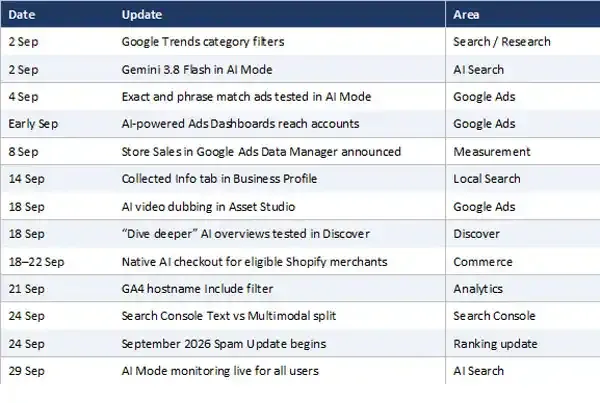
September 2026 at a Glance
What This Means for Businesses
SEO is no longer only about ranking a webpage. Businesses now need to ensure their content, products, services, local information and brand signals can be understood, trusted and surfaced by Google’s AI ecosystem.
This means focusing on technical SEO and a fast, well-structured website, high-quality, authoritative content, structured data, AEO/GEO, multimodal search, local SEO, accurate analytics and strong conversion tracking.
Conclusion: How TIC Can Help
As an experienced digital and content partner, TIC can help businesses adapt to this changing search landscape by combining SEO, AEO, technical optimisation, content strategy, website development and user-focused digital experience design.
From improving website discoverability and structured data to preparing content for AI-driven search and strengthening measurement, TIC can help businesses move beyond traditional SEO and build a search-ready digital ecosystem designed for both people and AI.



Let's create communication that drives results!