


Top Five SEO Fixes for Better Rankings
 5 Minutes Read

Technical SEO is no longer just about fixing 404 pages, improving page speed, or removing duplicate Meta descriptions. Those are the basics, and honestly, they are expected.
The real advantage today comes from fixing the technical gaps that most website developers, and even SEO professionals continue to ignore. These are the hidden issues quietly affecting crawl efficiency, indexing, user experience, and ultimately, rankings.
After auditing more than 500 websites over a decade of my SEO/AEO career, one thing has become very clear that most “Technical SEO/AEO” audits only scratch the surface. The actual issues that move rankings are usually the ones hidden deep inside server logs, rendering layers, crawl behaviour, JavaScript execution, internal link flow, and mobile usability. And the problem is that these areas are often boring, highly technical, and easy to overlook.
In this article, we will break down top advanced Technical SEO/AEO secrets that genuinely matter in 2026, including one issue many developers quietly ignore and another hidden ranking factor Google likely uses behind the scenes.
Let’s begin:
1. Log File Analysis - The SEO/AEO Audit Almost Nobody Does:
Most website owners and even many SEO/AEO professionals have never audited their server log files. And the surprising part? Tools like Ahrefs, SEMrush, or even Search Console will not show you the complete picture hidden inside them. Log file analysis reveals how Search engine bot actually behaves on your website.
It helps you understand:
- Which pages Google is crawling most frequently
- Where crawl budget is being wasted
- Hidden crawl errors not visible in Search Console
- Redirect chains and crawl loops
- Bot behaviour patterns
- Low-priority pages consuming resources
2. JavaScript Rendering Issues Are Still Hurting Rankings:
Just because a website looks perfect inside a browser does not mean crawlers see it the same way. Modern frameworks like React, Vue, and Angular often load important content only after JavaScript rendering. While search engines can render JavaScript, heavy rendering requires more crawl resources and Google allocates less crawl budget to rendering-heavy websites. This creates serious SEO/AEO risks.
Google may miss:
- Navigation links
- Internal links
- Important content blocks
- Product details
- Contact Form details
- Structured data elements
If major differences exist, Google may not be seeing your content properly.
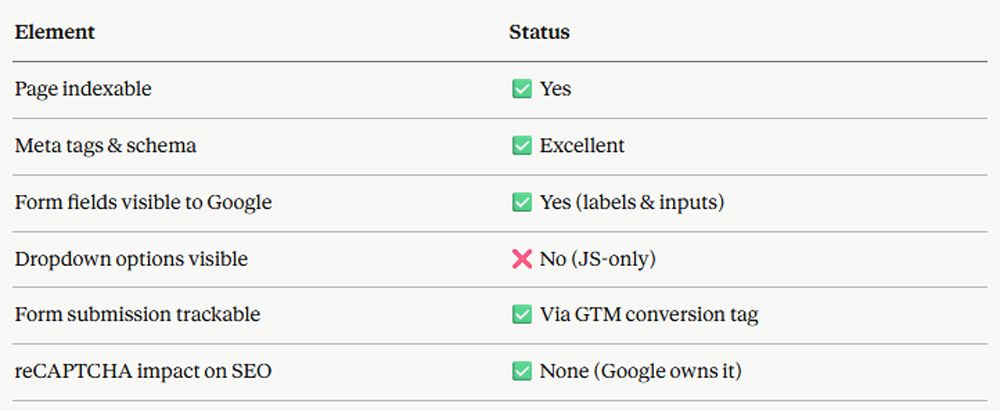
Example: “Contact Us” Page Audit: Dropdown fields — "Interested in" and "How did you hear about us?" are rendered as empty <div> elements, not native <select> tags. Googlebot sees blank dropdowns with no options
Best Practices:
- Use server-side rendering (SSR) whenever possible
- Keep critical content in static HTML
- Ensure navigation and anchor links exist in HTML
- Avoid depending entirely on client-side rendering
The more easily Google can access your content, the more efficiently it can crawl and index your site.
3. Render-Blocking Resources Still Destroy User Experience:
One of the biggest reasons websites feel slow is render-blocking resources. These are CSS, JavaScript, and font files that prevent the browser from displaying content until they finish loading. Until then, users often see a blank white screen.
Common problems include:
- Too many CSS files
- Unused JavaScript libraries
- Heavy custom fonts loading before content
- Analytics scripts blocking rendering
- Third-party w idgets slowing pages
- Chat boxes and social feeds delaying interaction
How to Improve It:
- Combine CSS files where possible
- Remove unused JavaScript libraries
- Load fonts asynchronously
- Delay non-essential scripts
- Use lazy loading strategically
- Audit third-party plugins regularly
Performance optimization today is less about “speed scores” and more about perceived user experience.
4. Schema Mark-up Gaps Are Costing You Clicks:
Most websites only implement basic schema mark-up like, “Organization Schema”, “Website Schema’, “Article Schema”. But advanced schema implementations can dramatically improve visibility and click-through rates. In some cases, rich results can improve CTR by 30% to 80%.
Commonly Missed Schema Types:
- FAQ Schema
- How-To Schema
- Summary Schema
- Video Schema
- Review Schema
- Breadcrumb List Schema
- Speakable Schema
Analyse which schema types competitors use successfully and identify opportunities missing from your own website. Use JSON-LD format whenever possible, since it is Google’s preferred implementation method.
5. Mobile UX Signals - The Hidden Ranking Factor:
This is one of the most underestimated ranking factors in Technical SEO/AEO. Google evaluates mobile usability very aggressively. And many websites still fail basic mobile UX expectations.
Common Mobile UX Problems:
- Small Font Sizes - If text is below 14–16px, users need to zoom manually.
- Clickable Elements Too Close - Together. Buttons overlapping or tightly packed create frustration.
- Horizontal Scrolling - If content exceeds the viewport width, usability drops immediately.
- Intrusive Popups - Full-screen mobile popups blocking content can trigger ranking issues.
- Sticky Elements Covering Content - Headers, footers, and chat widgets consuming large screen areas create poor usability signals.
Recommended Standards:
- Minimum body font size: 16px
- Ensure all buttons are easily tappable
- Avoid full screen mobile popups
- Keep sticky elements below 15% of screen height
Mobile SEO today is deeply connected to user experience quality. And Google knows when users are struggling.
Final Thoughts - Technical SEO/AEO in 2026 is no longer about ticking checklist items.
The websites winning today are the ones optimizing:
- Crawl efficiency
- Rendering accessibility
- Internal authority flow
- Real-world performance
- Mobile usability
- AI-friendly structured data
- User experience signals
As search engines become more dependent on AI systems, rendering efficiency, structured data, crawl prioritization, and technical accessibility will matter even more than before.
At TIC, we specialize in identifying these hidden SEO/AEO bottlenecks through in-depth technical audits, enterprise SEO/AEO strategies, and performance-driven optimization frameworks. From crawl diagnostics and JavaScript rendering analysis to schema implementation and AI-search readiness, TIC helps businesses uncover the technical gaps that directly impact search visibility and growth.
The websites that win in the next era of SEO/AEO will not necessarily be the loudest, they will be the most technically optimized behind the scenes.



Let's create communication that drives results!