



AEO Monthly News Updates: December 2025
 5 Minutes Read

This article is not just another news roundup. It is also a reflection on the evolution of SEO/AEO, AI, and digital marketing, and a necessary warning about misinformation and opportunism in the industry.
Back in 2019, when this journey began, Google had just started experimenting with AI driven systems like BERT. Even then, the focus was always on strong technical SEO/AEO fundamentals rather than shortcuts like backlinks. Topics such as JavaScript-based schema, Core Web Vitals, structured data, and site performance were discussed long before they became mainstream concerns.
Influencer marketers who don’t even understand basic marketing concepts. A concerning trend has been misleading claims such as, “Optimize your content for ChatGPT using Google’s EEAT.” This is fundamentally wrong because AI does not rank content, whereas search engines do.
The problem isn’t just misinformation. It’s the silence of professionals who choose to stay “nice” instead of speaking up. Every industry must self-regulate. If marketers don’t call out fraud, clients will lose trust in the entire field.
Major Digital Marketing & SEO/AEO Updates from December 2025:
1. YouTube’s Partner Match Program (Dec 1, 2025)
YouTube now allows advertisers to upload hashed third-party user data (such as email or phone lists) to target audiences. While this may improve ad efficiency, it raises ethical concerns because:
- This is not first-party data.
- Users did not directly consent to this use.
- Privacy risks remain significant.
2. Google’s AI Mode Becomes More Prominent - Google is gradually training users to accept AI Mode as a default experience by:
- Making “Read More” in AI Overviews open directly in AI Mode.
- Redirecting image upload clicks on the homepage to AI Mode.
- Slowly integrating AI responses into search behavior.
This is a strategic shift rather than a sudden overhaul. Google understands that changing user behavior must be gradual.
Lesson for businesses:
Instead of obsessing over every small UI change, focus on preparing your website, content, and brand for AI-first search.
3. Google Search Console Now Reports Social Presence in Search (Dec 8, 2025) - This is a powerful and often misunderstood update.
Google Search Console does not report traffic from social media. Instead, it reports: How often your social profiles appear in Google Search results alongside your website.
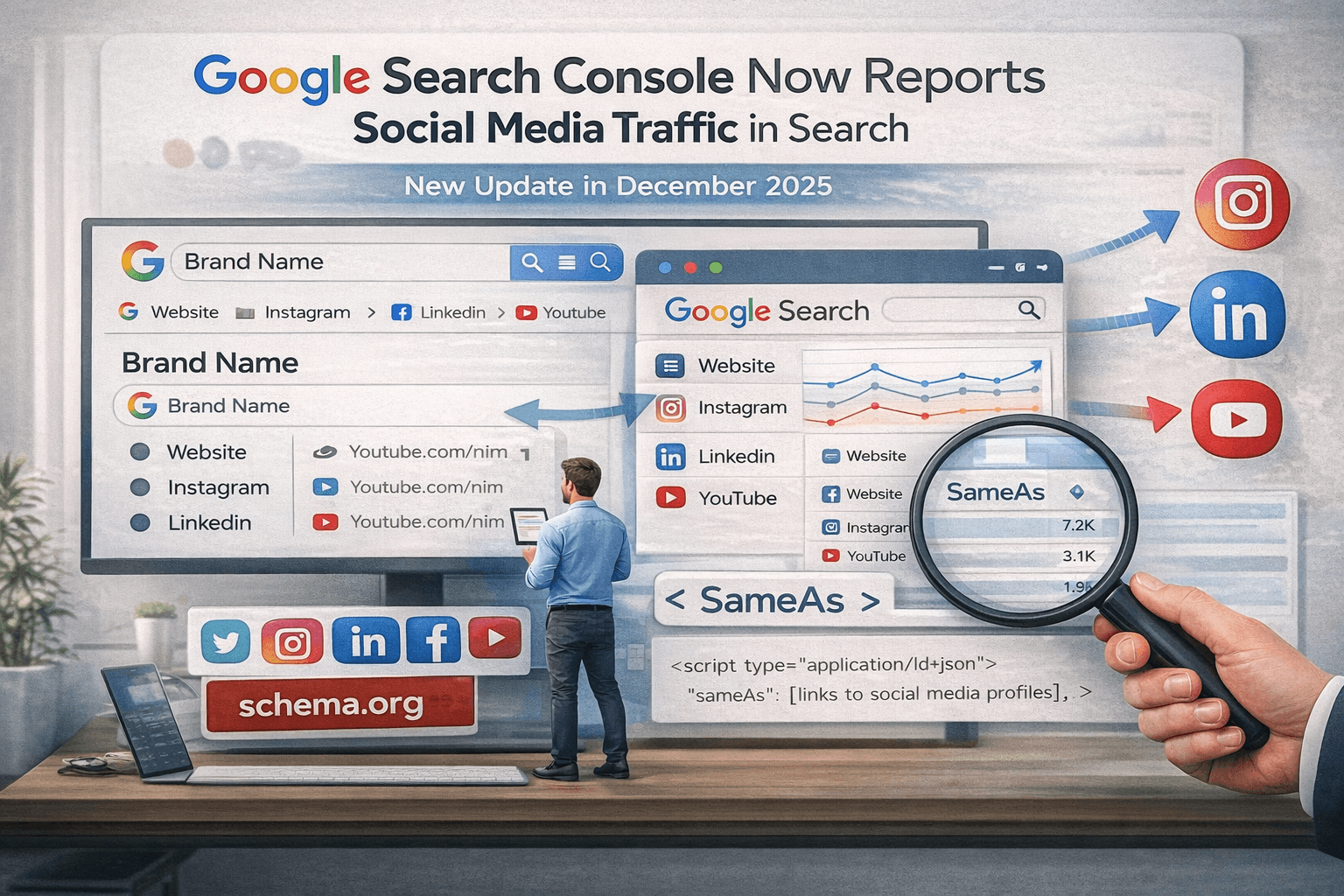
For example, if someone searches a brand and sees:
- Your website
- Your Instagram page
- Your LinkedIn post
- Your YouTube channel
And clicks on the social profile, that interaction can now appear in Search Console if Google recognizes that profile as belonging to your brand.
This recognition happens through “SameAs” Schema Markup, which connects your website to your official social profiles. Why this matters:
SEO/AEO is no longer just about websites. Brands can now prove that SEO/AEO also strengthens social visibility. Marketers can better justify their work using data.
4. Google Denies Ads in Gemini (For Now) - Google has stated that it currently has no plans to introduce ads in Gemini. However, it is highly likely that ads will eventually appear because nearly every major Google product monetizes through advertising.
For now, keeping Gemini ad-free puts pressure on OpenAI, which struggles to keep ChatGPT profitable without ads. This is less about user experience and more about competitive strategy.
5. Weekly & Monthly Views in Google Search Console (Dec 9, 2025) - A simple but extremely useful Weekly/Monthly Update: Instead of only seeing daily fluctuations in performance graphs, users can now view data in:
- Weekly format.
- Monthly format.
This makes long-term trend analysis far easier and more meaningful.
6. Google Data Manager API Launch - Google introduced a new API (Data Manager API) that allows businesses to feed their first-party data directly into Google’s ad and analytics systems.
Currently available for:
- Google Ads.
- Google Analytics.
- Display & Video 360.
This is another sign that Google is doubling down on AI-powered advertising using better data inputs.
7. Preferred Sources Now Available Globally
Users can now mark certain websites as “Preferred Sources” ensuring they appear more frequently in search results. This benefits brands that have built loyal audiences, because their visibility increases among engaged users.
8. AI Mode Shows More Links (Cosmetic Change) - Google added more outbound links inside AI Mode responses. This is largely a PR move to reduce criticism that AI is “stealing traffic” from publishers. However, the real impact on traffic remains minimal.
9. December Core Update (Dec 11–29, 2025) - Google rolled out a major core update with significant impact:
- Some high-traffic websites saw gains of 20–25%.
- Others experienced noticeable declines.
- Smaller websites were less affected overall.
As usual, Google did not provide detailed explanations, which has become standard practice.
10. “Read More” Link in Meta Descriptions:
Google sometimes replaces Meta descriptions with its own selected paragraph from a webpage. When this happens, a “Read more” link appears in search results, leading users to the exact paragraph Google used.
What this means for SEO/AEO professionals:
- Meta descriptions are suggestions, not guarantees.
- This is a learning opportunity to refine content clarity.
11. Google Sues SERP API for Illegal Scraping - Google filed a lawsuit against SERP API for:
- Scraping search results.
- Storing them.
- Selling them to AI companies like ChatGPT and Perplexity.
While many criticized Google as hypocritical, there is a key difference:
- Websites voluntarily allow Google to crawl them.
- SERP API repackaged Google’s indexed data and resold it without permission.
This case highlights a larger issue: AI companies are profiting from web content without compensating publishers.
Conclusion: Instead of reacting to every algorithm tweak, businesses need a steady, long-term strategy that aligns with where search and AI are headed. This means investing in strong technical SEO/AEO, clear brand positioning, high-quality content, and reliable data-driven reporting.
This is exactly where TIC Works can support businesses. TIC helps organizations future-proof their digital presence through solid technical foundations, intelligent website architecture, structured data implementation, and integrated performance tracking.
Some Useful Links:
#socialmediaservices #thoughtleadershipcontent #uxdesigningservices #websitedevelopmentservices #digitalmagazines #publications #casestudies #TICMumbai #abouttic #TICblogs #TICpodcasts #ourwork #ourclients #testimonials #contactus #careers #portfolio


Let's create communication that drives results!