


AEO Monthly News Updates: January 2026
 5 Minutes Read

January 2026 was not just another month in digital marketing. It was a power-packed start to the year, filled with product launches, AI integrations, privacy debates, monetization experiments, and strategic power moves from industry giants.
If you were too busy running campaigns, optimizing ROAS, or preparing Q1 strategy decks, don’t worry. This blog consolidates everything important that happened in January 2026, so you don’t have to hunt for individual updates.
Let’s dive straight into the updates.
1. Google Ads Change History Just Got Smarter:
On 5th January 2026, Google introduced a useful enhancement inside Google Ads, specifically in the change history tool. Now, when you select an individual change in the “Change History section”, a blue ribbon appears with a “Go To” option. Clicking it takes you directly to the exact location where the change was made.
No more hunting through campaigns, no more guessing which asset or setting was modified. For PPC professionals, this is a small update with big operational impact. Debugging just became easier.
2. Google Merchant Center Introduces “Subscribe & Save”
News from Google Merchant Center is rare, but this update on 7th January is significant. Merchants can now enable a “Subscribe & Save” promotional option, similar to what users see on Amazon. What does this mean?
If you sell recurring-use products, like pet food, you can:
- Offer recurring monthly deliveries
- Provide 4-5% additional discounts
- Promote these subscription benefits directly in Merchant Center
Additionally, abbreviations such as, BOGO (Buy One Get One), MRP, MSRP can now be used more naturally in promotions. For ecommerce brands, this improves communication clarity and increases recurring revenue potential.
3. Google Tag Gateway (Beta): First-Party Tracking Reinvented
Another major update came on 5th January, with the beta launch of “Google Tag Gateway” inside Google Ads. This feature allows Google Analytics and Google Ads tags to be served directly from your own domain.
Why is this important?
- Ad blockers are less likely to block scripts.
- Safari and privacy-focused browsers like Brave traffic become more visible.
- Conversion tracking improves.
- Data becomes first-party.
- GDPR-related friction reduces.
In simple terms: more reliable data, fewer blind spots. Yes, privacy debates continue, but from a marketer’s perspective, attribution just became stronger.
4. Performance Max: Video Asset Limit Increased (9th January)
In Performance Max campaigns, the video limit per asset group increased from 5 to 15. This is a strategic move. Users respond better to video. And when only one or two videos rotate repeatedly, ad fatigue sets in quickly.
Now, advertisers running larger budgets can:
- Rotate creative variations
- Reduce ad fatigue
- Improve engagement and conversion performance
5. AI Meets Commerce: Google Launches UCP
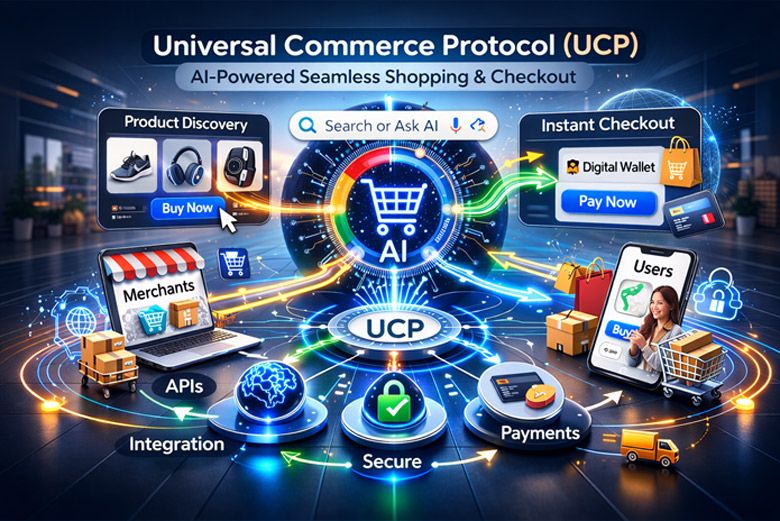
In January, Google introduced Universal Commerce Protocol (UCP), a bold step in AI-driven ecommerce.
- What does UCP do?
- It enables users to:
- Discover products in AI mode
- Click “Buy Now”
Complete purchases directly through Google Pay, without visiting the merchant’s website. Yes, you read that right. Google is no longer just an ad platform, it’s positioning itself as a transaction layer. Merchants must use “Google Pay” and payment commissions apply. This signals a shift: Google wants a share of transaction revenue, not just ad revenue.
6. Business Agent: Chat With Brands Directly in Search
Google also introduced a Business Agent feature. When someone searches your brand on Google, they can:
- Chat directly with your business from the search interface
- Without navigating your website
- Powered by Gemini, this reduces dependency on website browsing and potentially reduces hosting load.
However, to use this feature, businesses must be located in the US. Search is slowly becoming the interface.
7. Google Cloud Powers Apple Intelligence (12 January)
In a surprising strategic move, Google announced a multi-year partnership with Apple.
Under this agreement:
- Apple’s foundational AI models will run on Google Cloud.
- AI infrastructure for Apple Intelligence will rely on Google.
In the AI arms race, this is a significant development. It reflects how even major ecosystem players are now interdependent in AI infrastructure.
8. Gemini Personal Intelligence: Google launched Personal Intelligence inside Gemini.
If users opt in, Gemini can use data from:
- Gmail
- Google Photos
- Calendar
- YouTube history
To deliver hyper-personalized responses. This pushes AI assistants from generic models to context-aware systems.
Gemini Integrated Into Google Trends: Gemini was also integrated into Google Trends. This is arguably one of the most practical AI integrations. For SEO/AEO professionals and content strategists, this is a welcome enhancement.
9. Total Budget Feature in Google Ads (15 January): Google Ads introduced Total Budget for Search, Shopping, and Performance Max campaigns. Instead of:
Daily budget or Monthly budget - You can now:
- Set a total campaign budget
- Define a time period
- Let Google distribute spend automatically
It offers flexibility, but also increases dependency on Google’s algorithmic decision-making.
10. ChatGPT Introduces Ads
On 16th January, OpenAI announced ads inside ChatGPT for free, initially (US) users only. This marks the beginning of monetization beyond subscriptions. The era of AI platforms being ad-free is officially over.
11. AI Overviews + Gemini Pro Integration (17 January)
Google confirmed that AI Overviews can now leverage Gemini Pro models for higher-tier users. Quality improvement is noticeable, especially compared to earlier AI Overviews criticized for inaccuracies.
Key Takeaways from January 2026: January 2026 wasn’t just about feature updates. It was about power consolidation. January revealed three clear trends:
- AI Is Becoming the Interface - Search, shopping, personalization—everything is being AI-layered.
- Platforms Want Transaction Revenue - Google and OpenAI are both experimenting beyond ads.
- First-Party Data Is the Future - From Tag Gateway to Personal Intelligence, data control is central.
In a year where AI, automation, and data ownership are redefining digital marketing, partnering with TIC means having a proactive strategy team that understands both the technology and the business impact behind every update. Let’s not just adapt to 2026, let’s lead it together.
Some Useful Links:
#socialmediaservices #thoughtleadershipcontent #uxdesigningservices #websitedevelopmentservices #digitalmagazines #publications #casestudies #TICMumbai #abouttic #TICblogs #TICpodcasts #ourwork #ourclients #testimonials #contactus #careers #portfolio


Let's create communication that drives results!